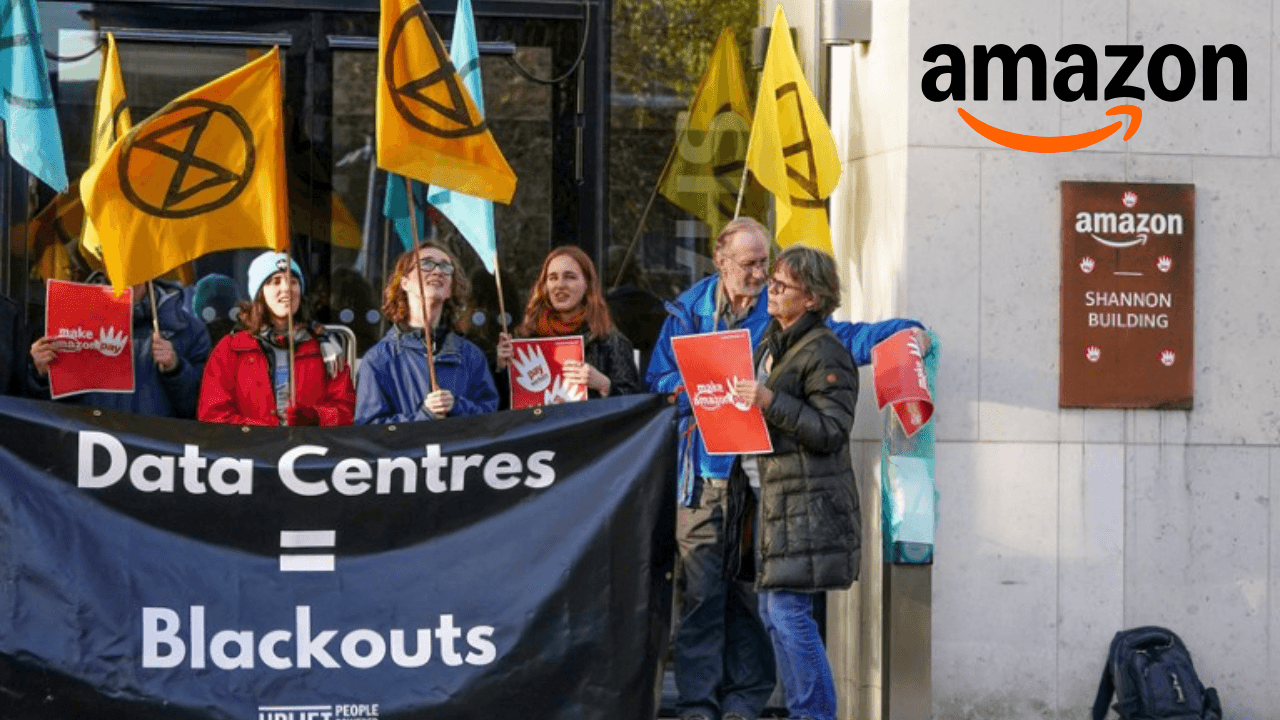
The Amazon employees AI protest has exploded into one of the biggest internal revolts against artificial intelligence at any global tech company. More than 1,000 staff have signed an open letter to CEO Andy Jassy, accusing Amazon of a “warp-speed” AI rollout that could damage jobs, the climate and even democracy itself. For Indian readers tracking AI, cloud, and big tech careers, this Amazon employees AI protest is a warning signal about how fast innovation can clash with ethics and worker rights.
Summary:
Amazon employees AI protest in 5 quick points
- Over 1,000 staff have joined the Amazon employees AI protest, signing an open letter that blasts the firm’s “all-costs-justified, warp-speed” AI rollout.
- Workers say Amazon’s AI race is widening its carbon footprint, with emissions rising roughly 35% since 2019 even as it promises net-zero by 2040.
- The Amazon employees AI protest highlights fears of job cuts, work speed-up, surveillance and layoffs linked to AI and automation.
- Employees accuse Amazon of using AI to help oil and gas firms and potentially support violence, mass deportations and a more militarized surveillance state.
- The protest lays out three big demands: no AI with dirty energy, no AI without employee voice, and no AI used for harm.
What sparked the Amazon employees AI protest?
The Amazon employees AI protest grew out of an internal campaign led by Amazon Employees for Climate Justice, a worker-led group that has previously challenged the company on sustainability. In the latest open letter, 1,000+ workers from teams including software, product and warehouses warn that Amazon’s current AI strategy could cause “staggering damage” to democracy, jobs and the Earth.
The protest is not just symbolic; employees say they build, train and run the AI systems Amazon is selling and deploying, so they feel directly responsible for what happens next. The Amazon employees AI protest frames this as a moral issue, arguing that they cannot stay silent while AI is rolled out at “warp speed” during a global climate crisis and rising authoritarian politics.
Climate fears: ‘dirty AI’ and data centre expansion
One of the loudest themes in the Amazon employees AI protest is the clash between AI growth and climate commitments. Workers say Amazon’s AI race is triggering huge investment in power-hungry data centres even as the company’s own figures show emissions have gone up by about 35% since 2019.
The letter claims Amazon plans to pour around 150 billion dollars into AI-centric data centres, including in drought-prone regions where they will consume precious water and push utilities to keep coal and gas plants running. As part of the Amazon employees AI protest, staff say this effectively creates “dirty AI”, where cloud and AI services are powered by fossil fuels while the company markets itself as climate-friendly.
AI and fossil fuels: why workers say this is a red line
Another sharp flashpoint in the Amazon employees AI protest is the company’s work with oil and gas giants. Employees argue that Amazon Web Services is selling AI and cloud tools that help fossil fuel clients drill more efficiently, which directly conflicts with the need to cut emissions rapidly.
Workers are demanding that Amazon stop using AI to support new oil and gas extraction, saying that this is incompatible with its own climate promises and global climate science. For many involved in the Amazon employees AI protest, this is not just a branding issue but a basic question of whether advanced technology will be used to accelerate or slow the climate crisis.
Jobs, layoffs and AI-fuelled workplace stress
The Amazon employees AI protest is also a response to deep anxiety about jobs and working conditions. The company has already cut thousands of corporate roles, and workers link these layoffs to increased reliance on AI tools and automation across teams.
CEO Andy Jassy has spoken about a future full of AI agents where remaining roles are “exciting and fun”, but employees say the reality feels very different. According to the Amazon employees AI protest letter, many staff are being pushed to use or build AI tools under tight deadlines, facing higher output expectations without matching investments in training, safety or career growth.
Warehouse workers and surveillance: the human side of AI
For frontline logistics and warehouse workers, the Amazon employees AI protest highlights a more physical kind of pressure. Workers say AI-driven systems are being used to enforce aggressive productivity quotas, increasing injuries, burnout and constant monitoring on the shop floor.
The letter also slams Amazon’s legal move to challenge the National Labor Relations Board (NLRB) in the US, which employees see as an attempt to weaken protections while AI tightens management control. Within the Amazon employees AI protest, this mix of layoffs, algorithmic surveillance and union pushback is seen as a dangerous model for the future of tech work globally, including in India’s growing warehousing and logistics sector.
Democracy and ‘techno-authoritarian’ AI
Beyond climate and jobs, the Amazon employees AI protest raises big questions about democracy and power. Employees warn that AI tools can be used to build a more militarised surveillance state, enable mass deportations and concentrate control in the hands of governments and big tech.
The letter notes that Amazon and other tech giants like Meta, Microsoft and Google have lobbied heavily against strong AI regulation at the state level for years. In the context of the Amazon employees AI protest, this lobbying is presented as part of a worrying “techno-authoritarian” direction, where AI is rolled out at speed while public safeguards lag far behind.
The three key demands of the Amazon employees AI protest
At the core of the Amazon employees AI protest are three sharp, easy-to-understand demands aimed at reshaping how the company builds AI.
- No AI with dirty energy: Workers want all AI-related data centres to run on additional, round-the-clock renewable energy instead of relying on fossil-heavy grids.
- No AI without employee voice: The Amazon employees AI protest pushes for ethical AI committees with real decision-making power, including non-managerial staff from across the company.
- No AI used for harm: Employees want binding commitments that Amazon will not develop or support AI systems for violence, mass deportations, or expanded fossil fuel extraction.
These demands turn the Amazon employees AI protest from a mere complaint into a concrete roadmap that other tech workers and Indian companies can study.
Why the Amazon employees AI protest matters for India
India is rapidly positioning itself as a global AI and cloud hub, with huge growth in IT services, startups and data centres. The Amazon employees AI protest shows what happens when speed, cost-cutting and “move fast” culture outrun ethics, climate responsibility and worker participation.
For Indian tech workers and founders, there are clear lessons from the Amazon employees AI protest: build AI with climate in mind, give employees a voice in deployment decisions, and think carefully about how tools might be used by governments, police or immigration agencies. Companies that ignore these signals may face similar backlash from their own teams in the coming years.
Conclusion:
The Amazon employees AI protest is more than just another big tech controversy; it is a turning point in how workers, climate advocates and AI builders push back from inside the system. As India races ahead with its own AI and cloud boom, the questions raised by the Amazon employees AI protest—about energy use, worker voice and democratic safeguards—will likely become central to our own tech debates in the years to come.